Jun 29, 2026
Claude Code Sub-Agents Need Visible Boundaries
Claude Code sub-agents make delegation useful, but they also hide responsibility, quota drain, MCP setup, and proof unless the workflow exposes boundaries from the start.
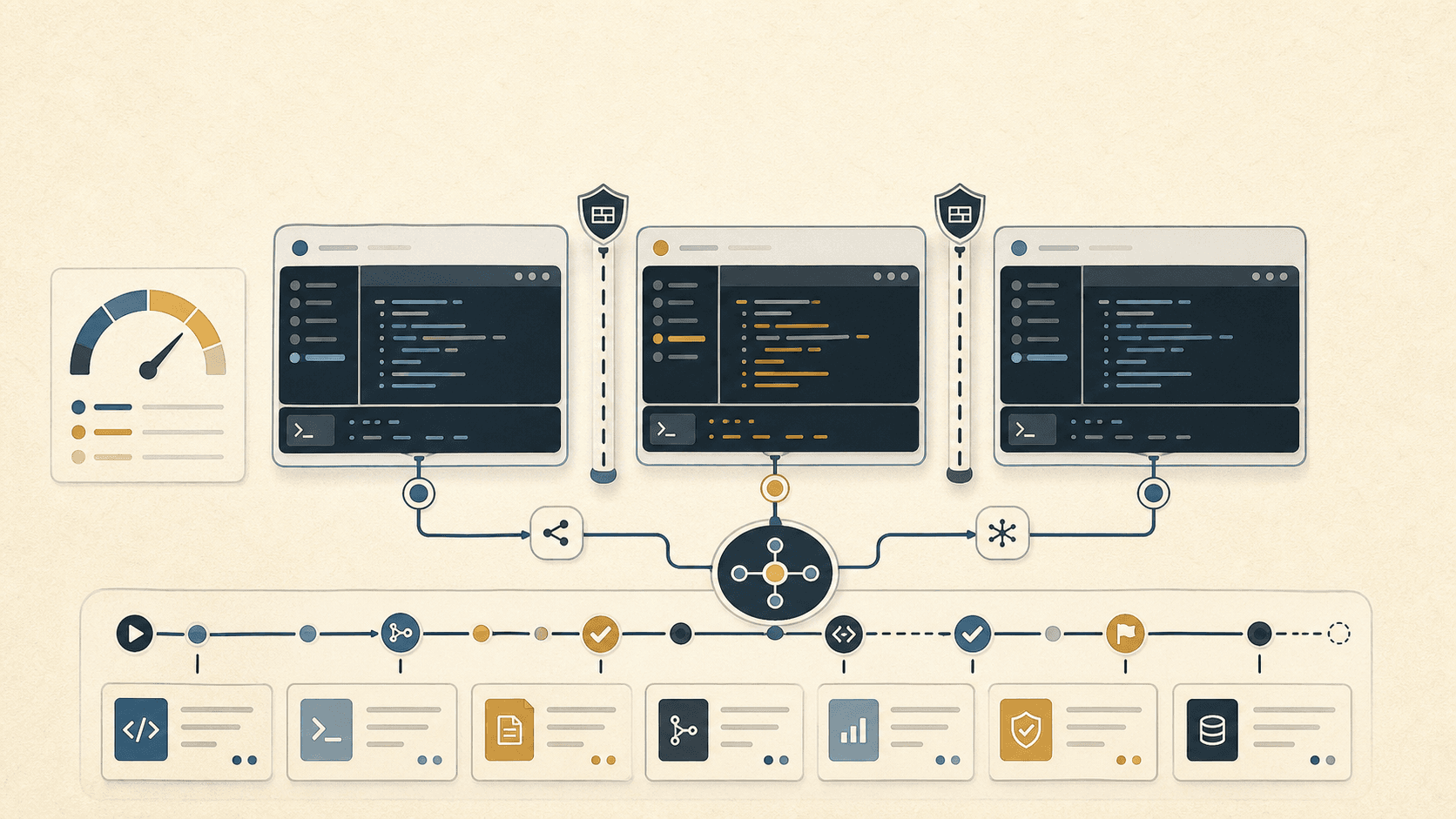
Sub-agents make AI coding feel less like a chat window and more like an operating system. That is useful, but it also changes the failure mode. When one assistant delegates to another, calls MCP tools, burns quota, edits files, and returns a clean summary, the human reviewer can no longer judge the work from the final paragraph alone.
The practical question for Claude Code users is not whether sub-agents are clever. The question is whether their boundaries are visible enough to trust. A serious workflow has to show who did what, which tools were available, where usage went, and what proof survived after the session ended.
Claude Code Sub-Agents Change the Review Problem
A single agent run is already hard to review when it touches multiple files. Sub-agents add another layer: one agent may plan, another may inspect, another may edit, and another may test. That can make the work faster, but it also makes responsibility less obvious.
If the only durable artifact is a success summary, the reviewer has to reconstruct the run from side effects. Which agent decided the scope? Which one used the database MCP server? Did the edit agent inherit the same repo rules as the planning agent? Did the verifier run the real test command or only inspect a file? Those are not philosophical questions. They determine whether a developer can accept the output without rereading the whole project.
This is why sub-agent workflows need a control surface, not just better prompts. The system should make delegation observable as it happens and reviewable after it ends.
Boundaries Need to Be Visible Before Work Starts
The cleanest time to define a sub-agent boundary is before the run begins. A reviewer should be able to see the planned roles, file scope, tool access, and stopping conditions. If an agent is only supposed to inspect logs, it should not silently edit source files. If a verifier is supposed to run tests, the command and result should become part of the record.
That boundary work sits next to the broader setup rules teams are already trying to standardize. A repo with AGENTS.md, CLAUDE.md, MCP configuration, and team conventions needs more than a pile of instruction files. It needs a visible way to confirm which rules each agent actually received. Otherwise the team has documentation without enforcement.
The same concern shows up in team setup rules for coding agents: the hard part is not writing a rule once. The hard part is proving the rule shaped the work every time an agent ran.
Quota Drain Is Workflow State, Not Billing Trivia
Sub-agents also make usage harder to reason about. A user may start one high-level task and watch the session spend context through planning, MCP schema loading, repeated inspections, failed browser checks, and multiple verification attempts. When usage disappears into a nested run, the developer is left guessing which part was valuable and which part was waste.
Quota awareness should be visible during the work, not discovered afterward. A useful control layer can show whether the planner is looping, whether a verifier is repeatedly retrying the same command, or whether a tool-heavy path is consuming context before the edit even begins.
That is why lifecycle, cost, and proof controls belong together. Cost is not separate from workflow quality. Waste often means the agent is stuck, underspecified, or using the wrong surface for the job.
MCP Workflows Need Packaging, Not Folklore
MCP turns agent workflows into something closer to local infrastructure. That is powerful because agents can reach databases, HTTP clients, design surfaces, file systems, and internal tools. It is also risky because every tool expands the surface area of a run.
A mature Claude Code setup should make MCP packaging visible: which servers are enabled, which agent can call them, what credentials or environment assumptions are required, and what logs prove the call happened. Without that, a team ends up with folklore. One developer knows the right local setup. Another copies half of it. A third agent fails because a schema changed or a tool was unavailable.
Good packaging is boring by design. It turns tool availability into something inspectable. It lets a reviewer distinguish a model mistake from an environment mistake. It also makes onboarding a new machine or teammate less dependent on memory.
Proof Should Survive the Session
The final output of a sub-agent run should not be a paragraph saying the work is done. It should leave a trail: plan, delegated roles, touched files, commands run, tool calls, test results, failed attempts, and handoff notes. The user may not read every line every time, but the evidence needs to exist when something looks wrong.
This is the same argument behind context budgets and review proof. AI coding becomes serious when the review artifact is stronger than the assistant's confidence. The agent can still be fast. It can still write most of the change. But the human reviewer needs a durable way to inspect the chain of work.
Sub-agents are not a reason to loosen control. They are a reason to make control more explicit.
The Workbench Is the Missing Layer
Claude Code, Cursor, Codex, and MCP tools are becoming normal parts of development. The gap is the workbench around them: role boundaries, reusable setup, usage visibility, and proof that can survive the chat.
That layer does not replace engineering judgment. It protects it. Developers should get faster without losing the habit of asking what changed, why it changed, and how they know it worked.
A sub-agent workflow is only as trustworthy as the record it leaves behind.