Jun 30, 2026
AI-Built Apps Need Crawlable Output Before Review
AI-built apps need crawlable app output, visible rules, and review evidence before another agent or human can trust what the browser demo appears to show.
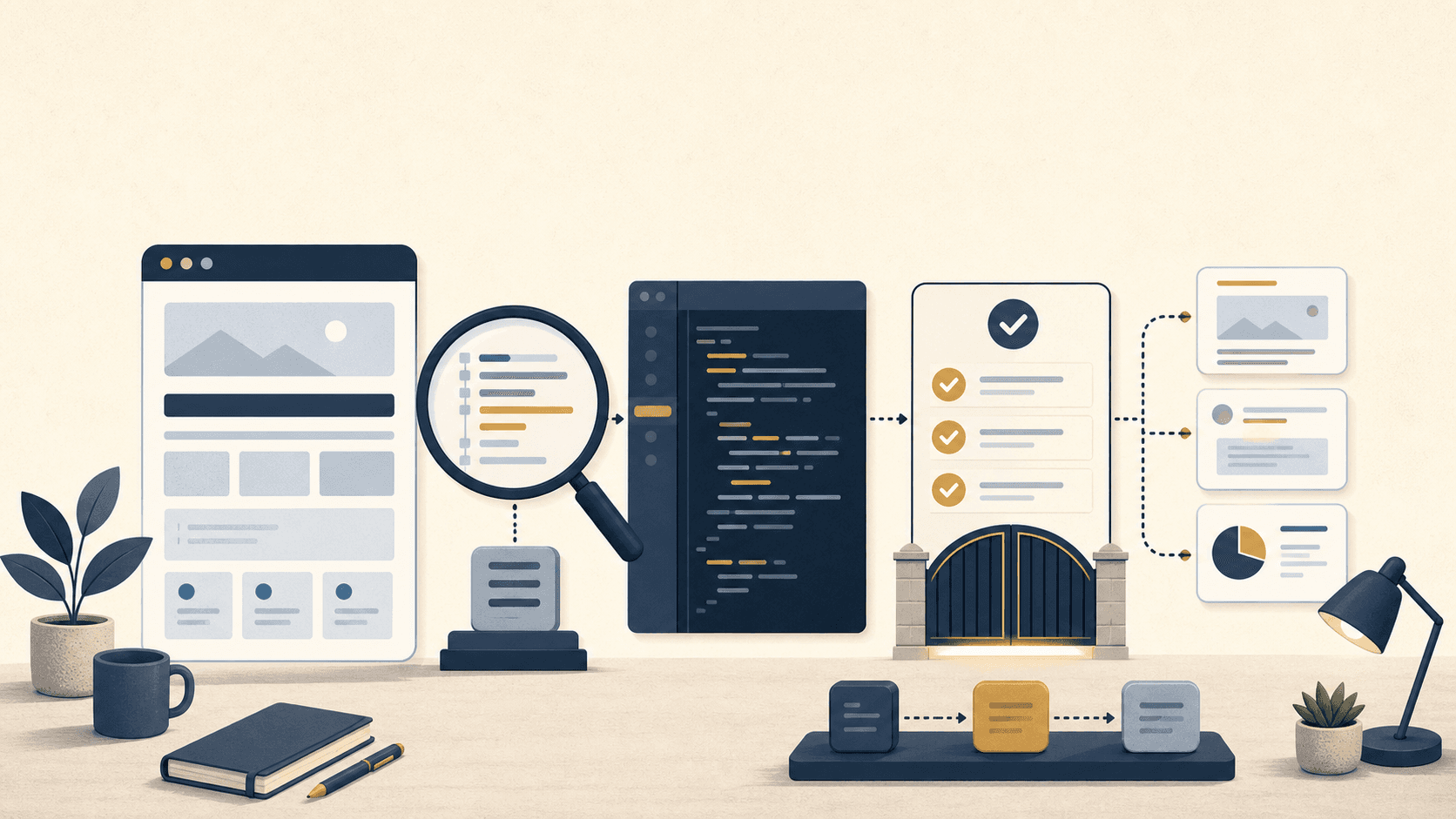
AI-built apps often fail at the exact moment they look finished. The interface loads in a browser, the local demo works, and the screenshot looks plausible, but the meaningful content is locked behind client-side state that a crawler, reviewer, or second agent cannot read.
That is not an SEO footnote. It is an engineering review problem. When the output of an AI-assisted build is not inspectable without running the same JavaScript path, every downstream check becomes more expensive: search visibility, social previews, accessibility review, documentation, agent handoff, and human trust.
Crawlable App Output Is Review Infrastructure
A single-page app can be technically functional and still be hard to review. If the route ships an empty shell plus a bundle, the browser user may see a polished page after hydration, while a raw HTML fetch shows little more than a root div. That gap matters more when AI coding tools produce more of the surface area.
Crawlable app output means the important page facts are present in the document before a specialist environment does extra work. The title, headings, primary copy, canonical links, useful empty states, and critical navigation should survive a simple HTML read. The goal is not to abandon modern frameworks. The goal is to make the rendered contract visible to tools that do not share your local browser session.
This is the same reason proof trails come before agent handoffs. A reviewer should not have to trust that the app looked right on one machine. They should be able to inspect the route, see what was rendered, and compare it against the task without reconstructing the entire session.
The Viewer Is No Longer Only a Browser
The old assumption was simple: if Chrome renders the page, the page exists. That assumption is now too narrow. AI-built work is inspected by preview panes, link unfurlers, search crawlers, accessibility tooling, code-review bots, LLM crawlers, and agents asked to summarize or critique the output.
Those readers do not all run the same scripts, wait for the same requests, or hold the same auth state. Some will execute JavaScript poorly. Some will not execute it at all. Some will see a loading shell and decide there is nothing worth indexing or reviewing. The result is a strange kind of invisibility: the app works for the builder but disappears for the systems that decide whether it can be trusted.
Good output leaves a trail outside the happy-path browser. Server-rendered text, route metadata, stable headings, and deterministic preview states give non-human reviewers something concrete to read. Even when the final product remains highly interactive, the first layer should communicate what the page is, why it exists, and which claims the implementation is making.
Hidden State Raises Agent Cost
Cost-aware Claude and agent workflows are not only about subscription tiers or token limits. They are also about how much work the agent has to repeat because the project hides its own state.
When an app's output is opaque, the next agent burns context asking basic questions. What does this page say? Which route is under review? Was the empty dashboard intentional? Did the pricing card render, or is the browser masking a data failure? Every missing surface fact turns into another screenshot, another browser pass, another prompt, or another brittle summary pasted into chat.
That is why context budgets and review proof are now coding infrastructure. The cheapest context is not compressed prose after the fact. It is a project that exposes enough durable evidence that humans and agents can inspect it directly.
A practical workflow treats raw output as part of the build artifact. Before asking another model to review the app, capture the route HTML, the browser screenshot, the console state, the network errors, and the commands that produced them. The more of that evidence lives near the work, the less the next session depends on memory or belief.
Rules Need to Travel With the App
Crawlability also depends on team rules. One developer may remember to add metadata and semantic headings. Another may optimize only for the interactive demo. A coding agent may follow whichever instruction file happened to be present in the workspace that day.
For AI coding teams, this drift is predictable. Project rules, reusable prompts, model-specific skills, local commands, and review expectations spread across machines unless somebody turns them into a maintained operating layer. The same app can be built under different assumptions depending on which laptop, shell, or agent session produced the change.
That is why teams need setup rules before agents write code. Crawlable output should be one of those rules. Not as a vague preference, but as a checklist item: every public route needs meaningful title text, descriptive headings, useful fallback content, and a way to verify what a non-browser reader sees.
Rules are most useful when they are close to the action. If the app expects review proof, keep that expectation in the project context, command templates, and handoff notes. If a route must be crawlable, make the test repeatable enough that an agent can run it before declaring the work done.
Trust Is Earned Before the Pull Request
Open-source contributors are already feeling the trust damage around AI-generated changes. A correct fix can still be dismissed when the surrounding evidence looks thin, the explanation sounds generic, or the author cannot show how the result was checked.
Crawlable app output will not solve that alone, but it removes one avoidable source of doubt. A reviewer who can fetch the route, inspect the meaningful content, see the commands, and compare the result with a visible checklist has less reason to treat the contribution as a black box. The work becomes easier to accept because its claims are easier to test.
This is the practical standard for AI-built apps: the output should be visible outside the builder's live session. The route should say what it is. The review should show what changed. The rules should explain what was expected. The evidence should survive after the chat is gone.
A Simple Test Before Handoff
Before handing an AI-built app to a reviewer or another agent, run the boring checks. Fetch the page without relying on the browser UI. Confirm the page title, primary heading, core copy, canonical URL, and critical links are present. Open the screenshot and compare it with the raw output. Save the command, result, and any caveats next to the task.
Then ask the review question: could someone understand the page's purpose without your local dev server, your memory of the prompt, or your screenshot narration? If the answer is no, the app is not ready for review. It may be ready to demo, but it is not yet ready to be trusted.
AI coding makes it easier to produce interfaces quickly. Crawlable app output makes those interfaces easier to inspect, index, hand off, and defend.