Jun 30, 2026
Deterministic Context Folding Belongs in the Agent Control Plane
AI coding agents need context reduction that preserves exact paths, ids, hashes, commands, and review facts instead of blurring production evidence into summaries.
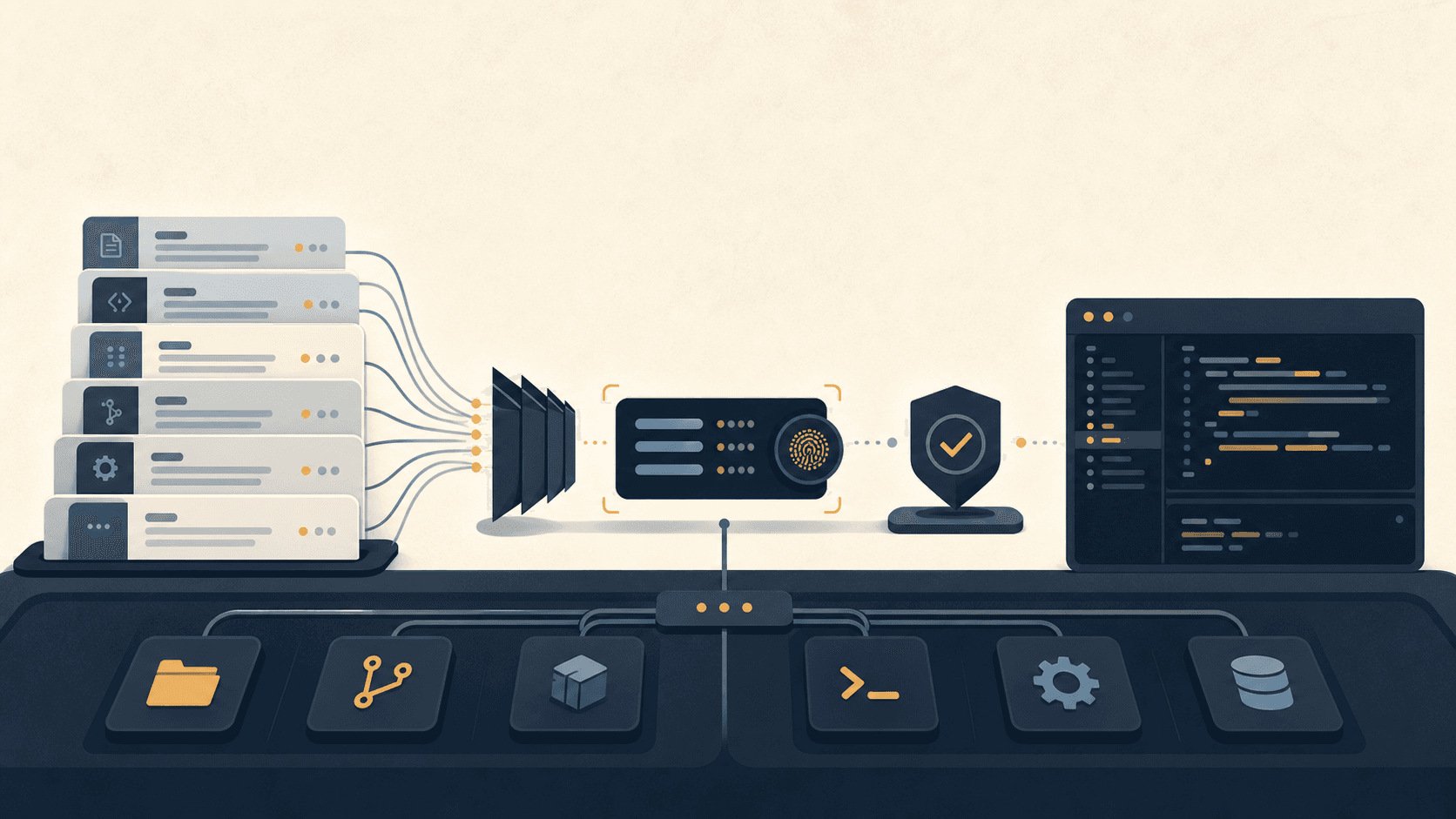
AI coding agents do not fail only because they lack context. They also fail because their context cannot be trusted after it has been compressed, summarized, reordered, or carried across a long session. The dangerous part is subtle: a summary can sound coherent while losing the exact path, identifier, hash, command, or constraint that made the work safe.
That is why deterministic context folding is becoming part of the agent control plane. It is not a prettier summary. It is a way to reduce context without turning hard evidence into soft memory.
Deterministic Context Folding Is Not Summarization
A normal model summary is useful for prose and weak for infrastructure. It can preserve the theme of a task while losing the details that production work depends on. A file path becomes “the config file.” A cache key becomes “the build cache.” A failing command becomes “tests failed.” Those shortcuts are fine for a human status update and dangerous as input to the next agent run.
Deterministic context folding has a different job. It keeps exact anchors stable while reducing the surrounding material. Paths, ids, hashes, command names, file lists, and review facts should survive the fold because they are the things a later agent must not improvise.
That distinction matters for teams using agents on real repositories. The agent does not need every word from the last session. It needs the right facts in a form that can be checked.
More Context Can Make Production Work Worse
Large context windows make it tempting to carry everything forward. That feels safe until the session contains stale assumptions, dead branches, abandoned plans, and old errors mixed with the current state. The agent now has more to read and less reason to know what still matters.
This is the same failure mode behind context rot. The model may still be capable, but the workflow feeds it polluted memory. Folding is only valuable when it removes noise without destroying evidence.
A good fold should answer a narrow operational question: what does the next agent need to continue safely? If the answer cannot distinguish current facts from discarded ideas, the fold is just another prompt blob.
The Fold Needs a Review Surface
Context folding should not happen invisibly. Developers need to see what survived, what was dropped, and which source artifacts back the compact packet. Otherwise the folded context becomes another unreviewed model output, and the next run inherits its mistakes.
A useful review surface can show the inputs, the folded packet, and the preserved anchors. It can let a developer spot missing file paths before the agent starts. It can also make stale context obvious: a deleted file, an outdated branch, a replaced dependency, or a test command that no longer applies.
This is where folding connects to context budgets and review proof. Budgeting context is not only about spending fewer tokens. It is about deciding which facts are worthy of future trust.
Production Agents Need Architecture Boundaries
Prototype work can tolerate loose context. Production work cannot. When an agent is asked to touch architecture, security, billing, data models, or deployment paths, the context packet has to carry boundaries as well as instructions.
The human still owns the tradeoffs. An agent can inspect code, propose a patch, run commands, and gather evidence. It should not silently decide which architecture constraint no longer matters because that constraint fell out of a summary.
Deterministic folding helps only if it preserves the parts of architecture that should constrain the run: ownership boundaries, migration state, risky files, known invariants, and the verification commands that count as proof.
Local Tool Stacks Need Stable Handoffs
Modern agent workflows are no longer one chat and one editor. They involve Claude Code, Codex, Cursor, local model runners, MCP servers, HTTP clients, databases, shells, and test harnesses. Each tool sees a different part of the system.
The control plane has to make those handoffs stable. If a local tool produced evidence, the folded packet should preserve where that evidence came from. If an MCP call changed what the agent could see, the next reviewer should know. If a session moved from planning to editing to verification, the boundaries should remain visible.
That is why folding belongs beside agent lifecycle, cost, and proof controls. A compact context packet is not enough by itself. It has to sit inside a workflow that records what happened and proves what changed.
Compact Context Should Make Review Easier
The goal is not to make agents autonomous by hiding more state in a clever packet. The goal is to make the next human review easier. A good folded context packet is small enough for an agent to use, precise enough for a human to audit, and stable enough to survive a tool switch.
That is the standard production AI coding needs. Context should be compressed, but not blurred. Agents can move faster when the control plane preserves the exact evidence they are not allowed to forget.