Reader Mode
Read an agent's conversation as a document instead of a terminal dump — with a live terminal in a resizable split beside it.
An AI agent's terminal is a stream of redrawn frames. It is fine to watch and awful to read: line breaks land mid-word, **markdown** shows up raw, and a long session is reduced to the few hundred words still on screen.
Reader Mode re-renders the conversation as a document.
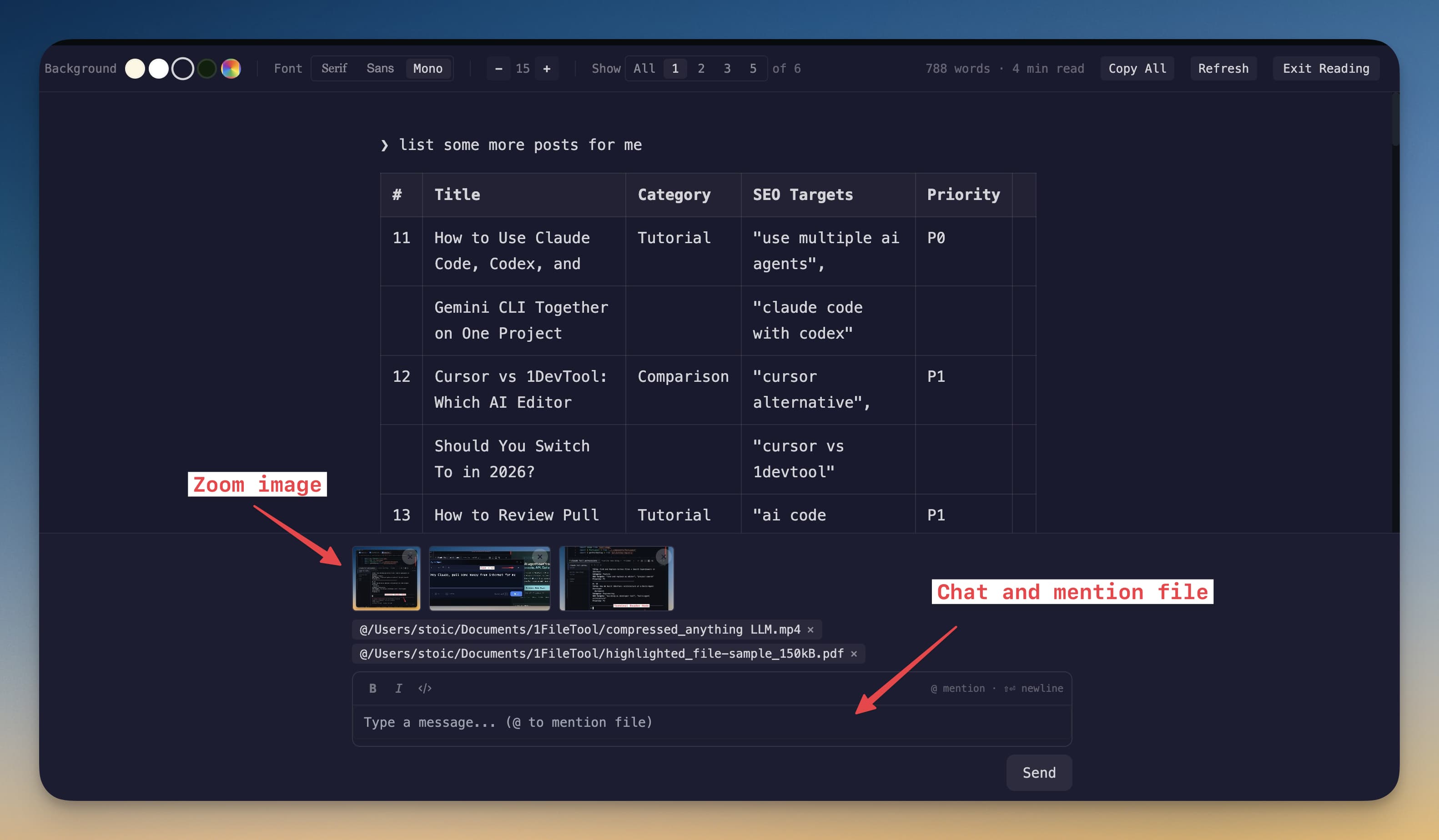
Opening it
Press Cmd+Shift+E (Ctrl+Shift+E on Windows and Linux) in a terminal, or click Open in Reader Mode in the terminal's header. The shortcut can be rebound. Reader Mode works on Markdown files in the editor too, and it coexists with Agent Input, so you can keep reading and still send a prompt. Press Esc or Exit Reading to leave.
What it fixes
- The full transcript, not just what fits on screen
- Real paragraphs, headings, lists, and code blocks
- Terminal chrome (banners, status lines, box drawing) stripped out
- Claude Code, Codex, Gemini, Cursor, Kimi, Qwen, Grok, OpenCode, Cline, Hermes, Antigravity, Pi, Oh My Pi, Kiro and Devin render their real parsed native session, not a scrape of whatever happened to be on screen. Custom agents and shells fall back to the terminal's screen text.
The reading view
Since v1.75.0 Reader Mode is laid out like a document.
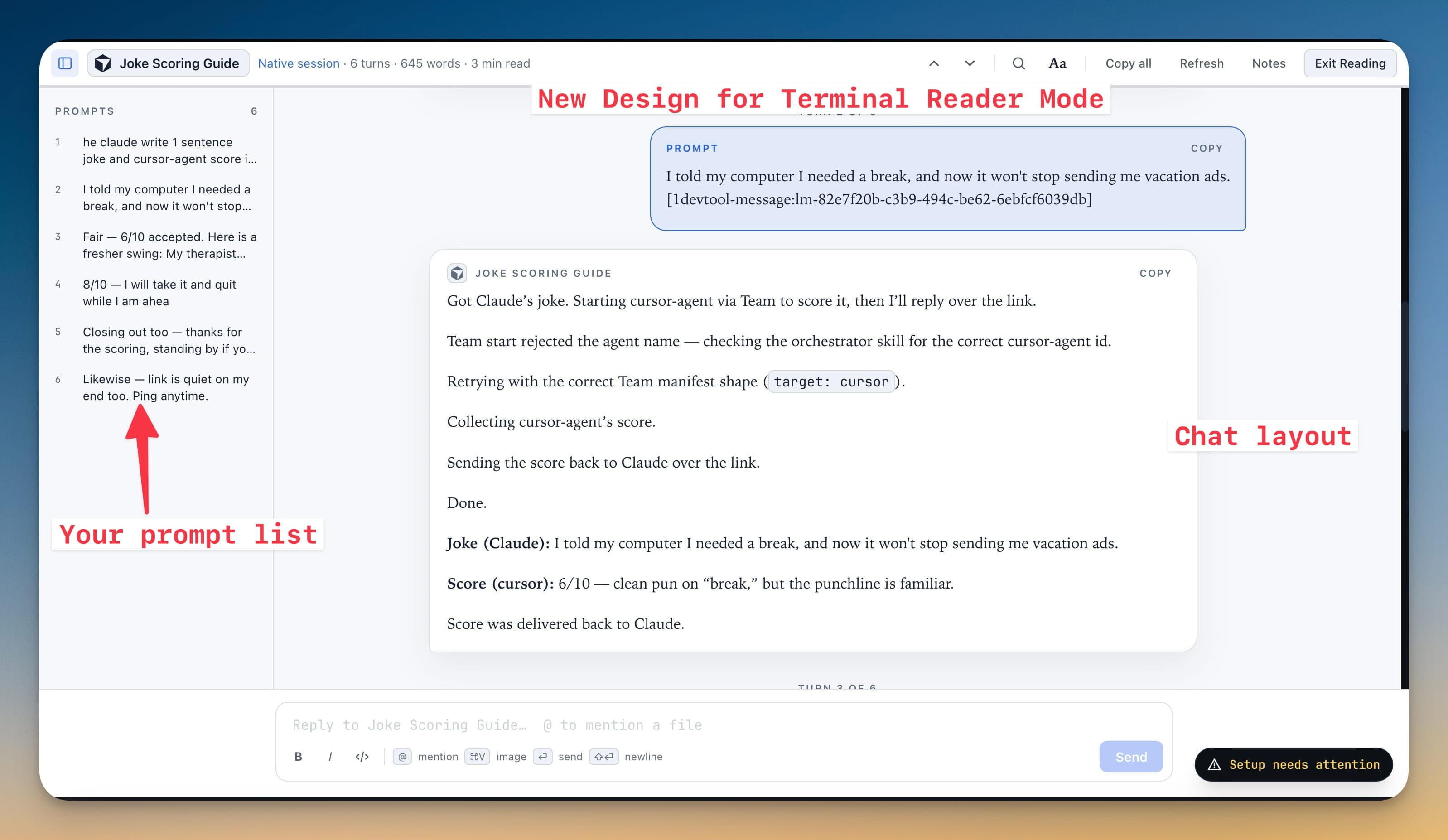
The header names the session and where the transcript came from (Native session, Terminal screen or Terminal output), then shows the turn count, word count and reading time. While the agent is still running it reads Agent still working · Refresh. From left to right, the controls are:
- Previous prompt (
⌥↑) and Next prompt (⌥↓) - Find in transcript (
⌘F) - Aa, for reading settings
- Copy all, which copies the turns currently shown, separated by
--- - Refresh, Notes and Exit Reading
The Prompts rail on the left lists every prompt you sent, numbered. Click one to jump to its turn. Each turn is labelled Turn N of M and has its own Copy button.
Reading settings
Aa opens the Reading popover:
| Setting | Options |
|---|---|
| Canvas | Dark, Black, Sepia, Paper, Forest, or Custom colors with your own Background and Text |
| Typeface | Serif, Sans, Mono |
| Size | − / + |
| Measure | Snug, Comfort, Wide (the width of a line of text) |
| Layout | Document, or Chat (prompts and replies as cards) |
| Show | 1, 3, 5 or 10 turns, or All |
Canvases saved before v1.75.0 carry over: White is now Paper and Green is now Forest.
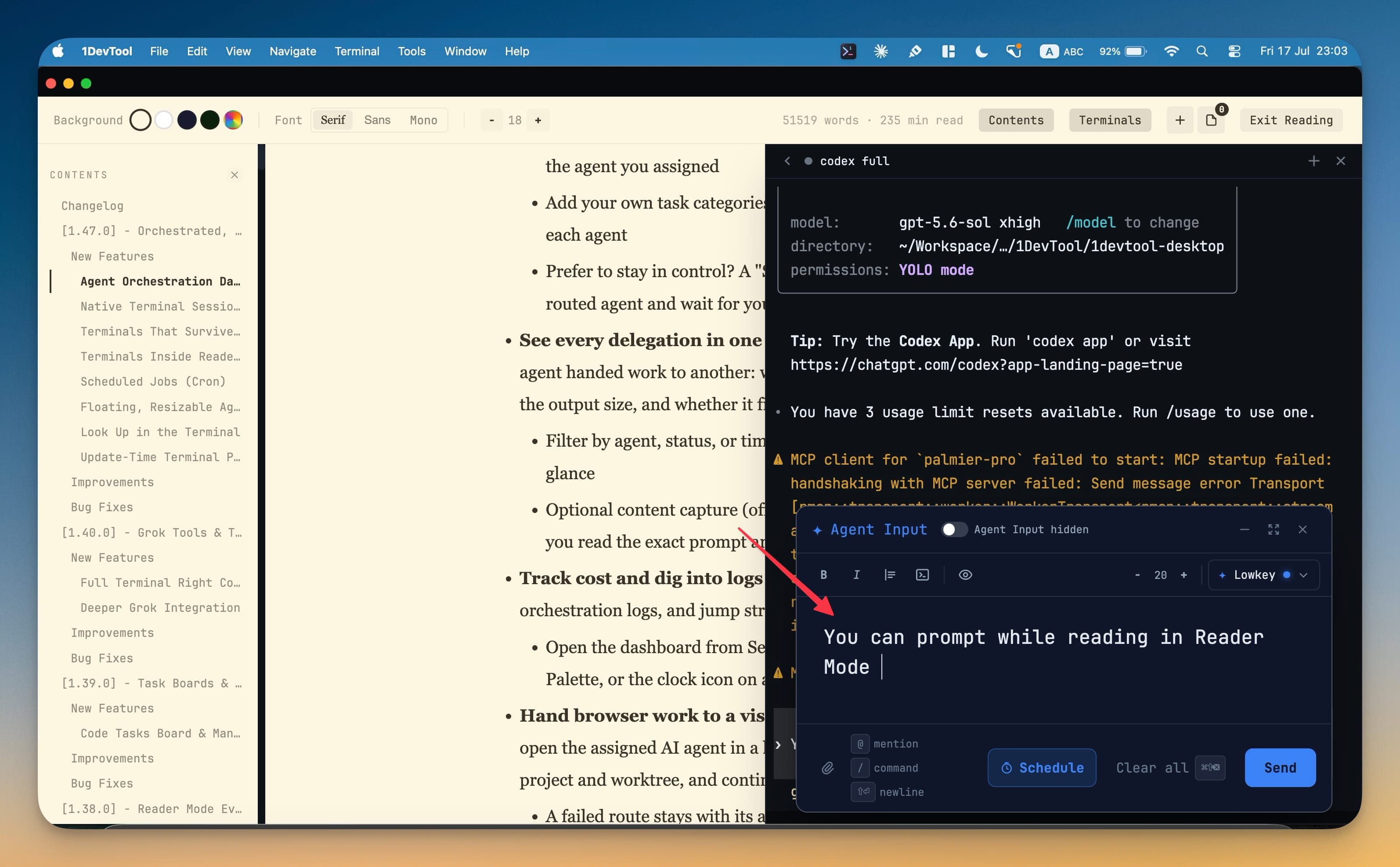
A terminal beside it, in a real split
While reading a Markdown file in Reader Mode, you can put any of the project's terminals in a pane beside the document — a real, live terminal with full output, scrollback, and Agent Input, not a static copy.
Since v1.70.0 this is a genuine split rather than a dock floating over the page, so the terminal never covers the paragraph you are reading. Pick a layout from the reader toolbar:
| Preset | Layout |
|---|---|
| 5 : 5 | Markdown 50% · terminal 50%, side by side |
| 3 : 7 | Markdown 30% · terminal 70% |
| 7 : 3 | Markdown 70% · terminal 30% |
| MD / Term | Markdown above the terminal |
| Term / MD | Terminal above the markdown |
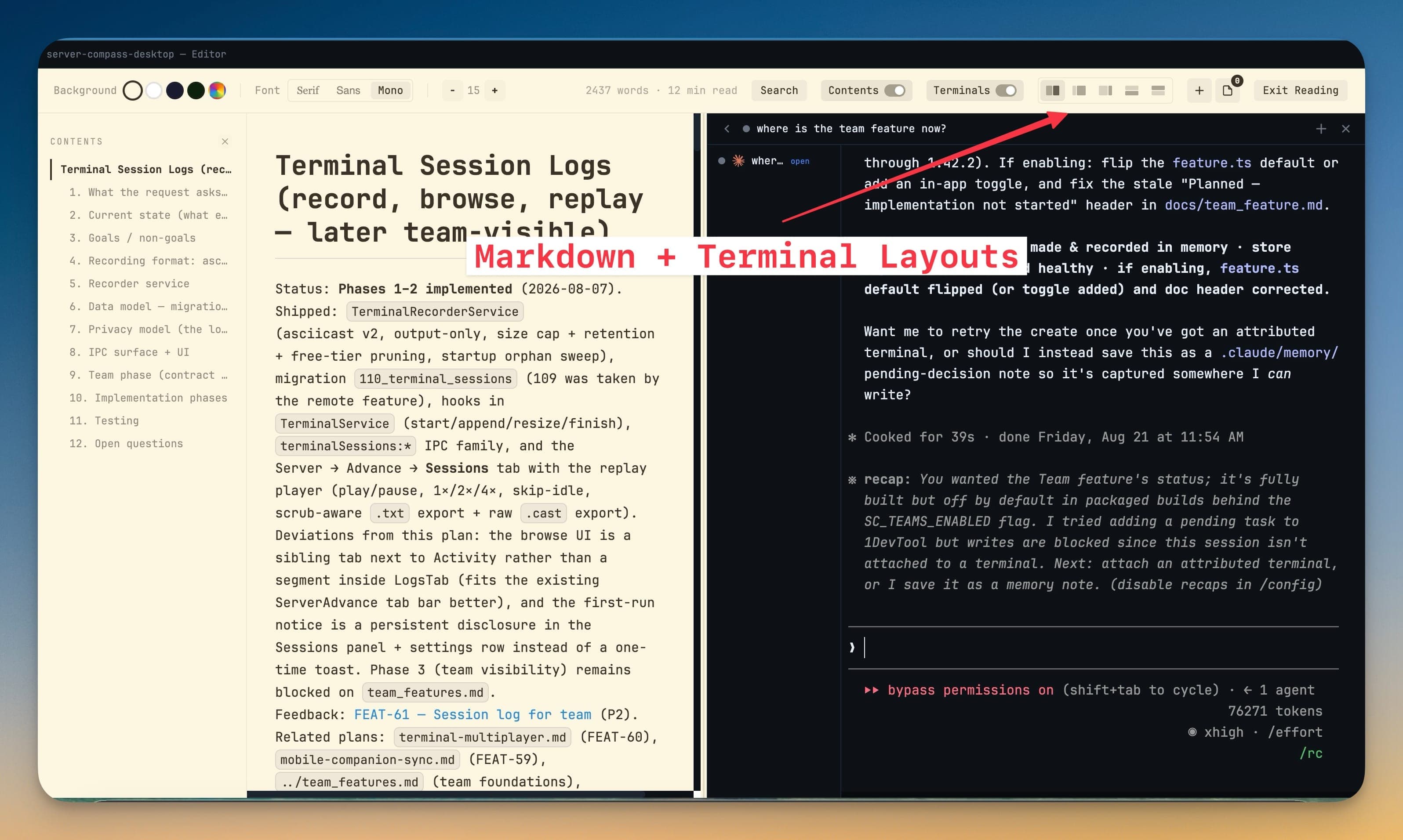
Drag the sash between the panes to fine-tune the ratio — the layout you settle on is remembered for next time. Stack the panes instead when the document has long lines and you would rather give it the full width.
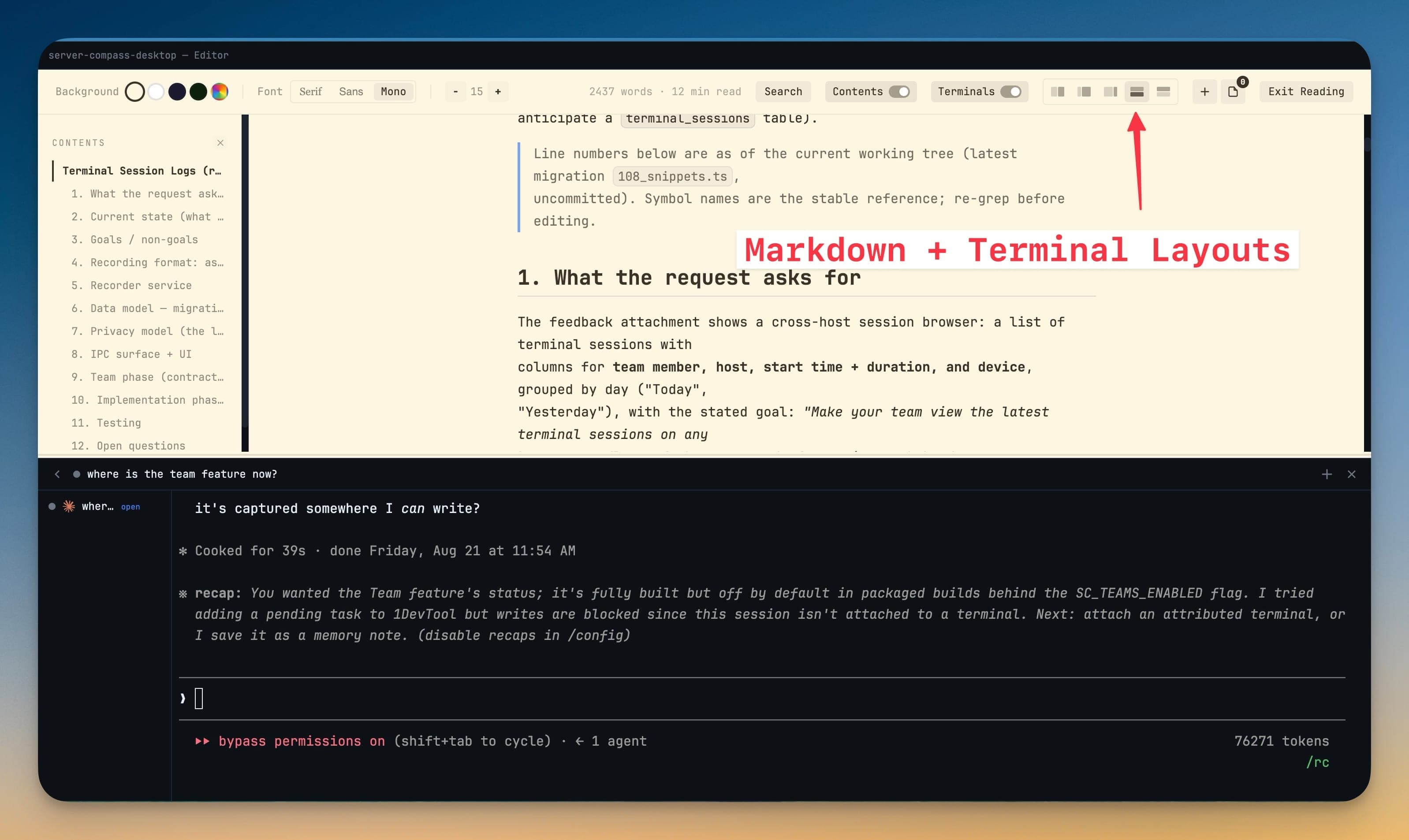
You can also create a brand-new terminal from the reader, and closing the pane hands your scrollback back cleanly so nothing is lost.
Prompting while you read
The composer sits at the bottom of Reader Mode for AI agents, so noticing something halfway down a transcript and asking about it does not mean leaving the reading view. Type @ to mention a file, paste an image to attach it, drop files onto it, and use the B, I and code buttons for formatting.
Notes in Reader Mode
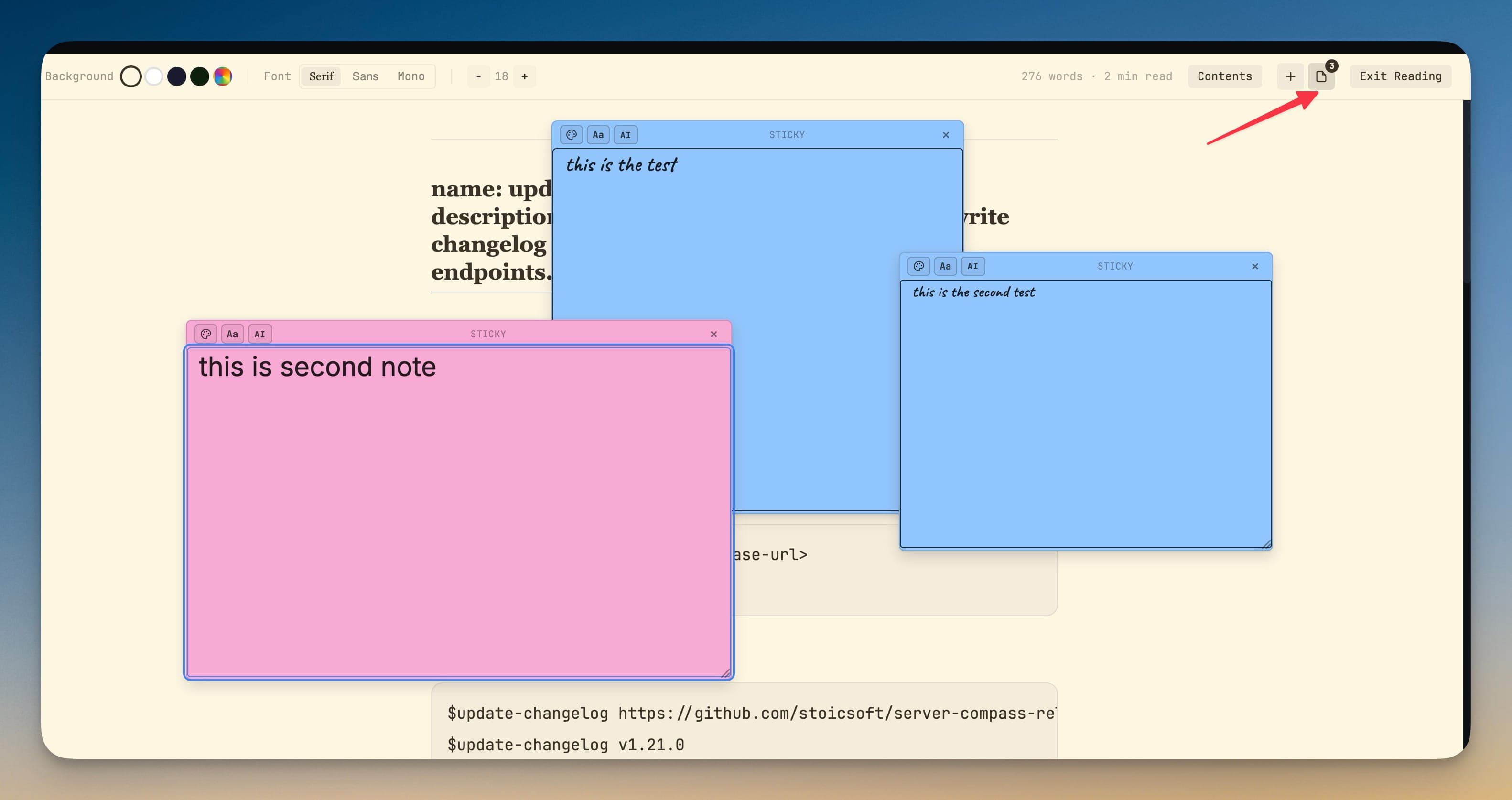
Sticky notes render alongside the document, so annotations you left on a file are visible while you read it. See Sticky Notes.
On your phone
Reader Mode is the best way to catch up on an agent from a phone, and it is available there too. The phone version styles user messages, agent results, code, and raw terminal output separately. Since v1.75.0 it uses the same Dark, Black, Sepia, Paper and Forest canvases, Serif, Sans or Mono type, Snug, Comfort or Wide measure and Document or Chat layout as the desktop, so a session reads as the same document everywhere. It also has a Prompts sheet, Find in transcript, and a Latest or All turns switch. Custom colors are desktop-only.
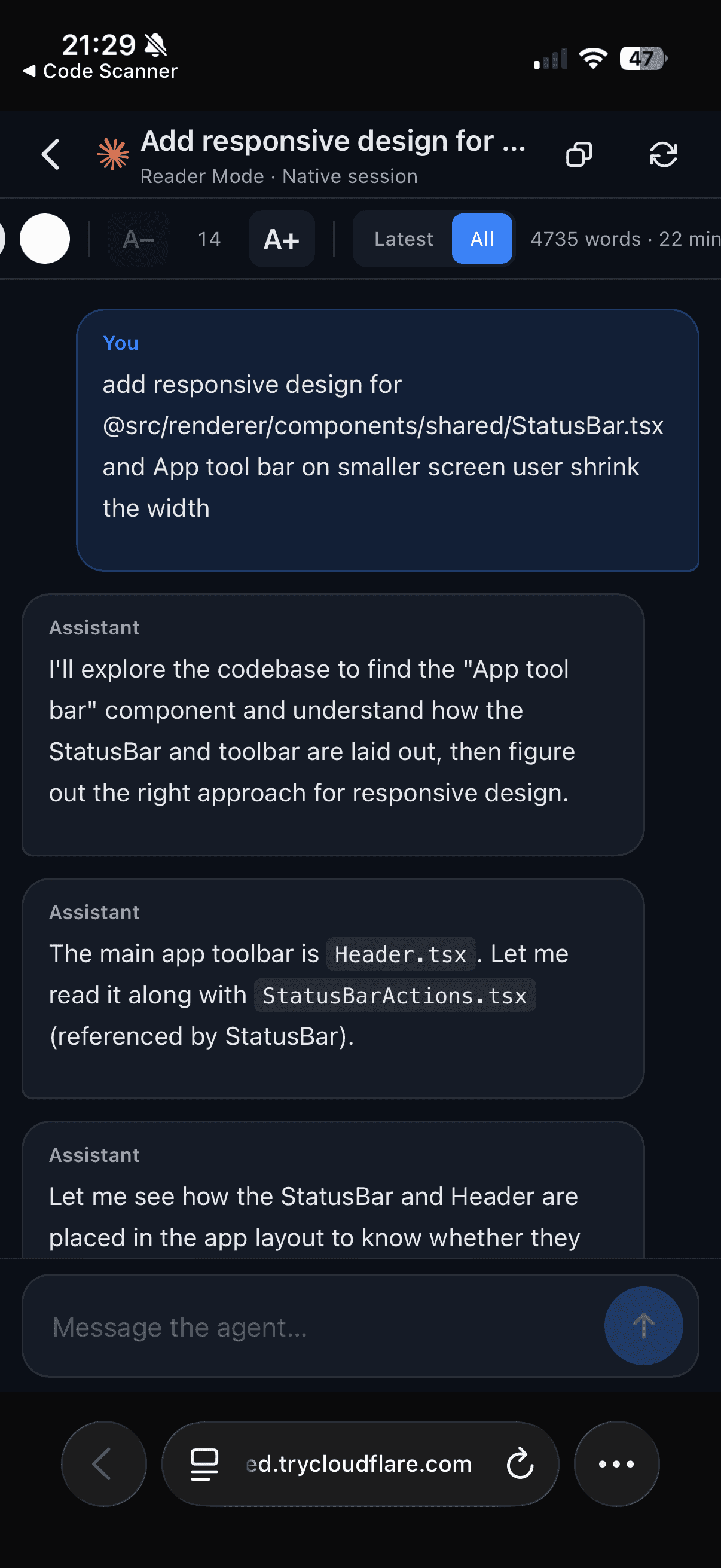
It also re-renders the transcript at any width, which makes it the escape hatch when a desktop-width terminal is unreadable on a small screen.
Themes
Reader colours inherit the reading canvas you pick under Aa rather than the app's terminal palette, so a dark app can still give you a Paper or Sepia reading surface if that is what you prefer.